
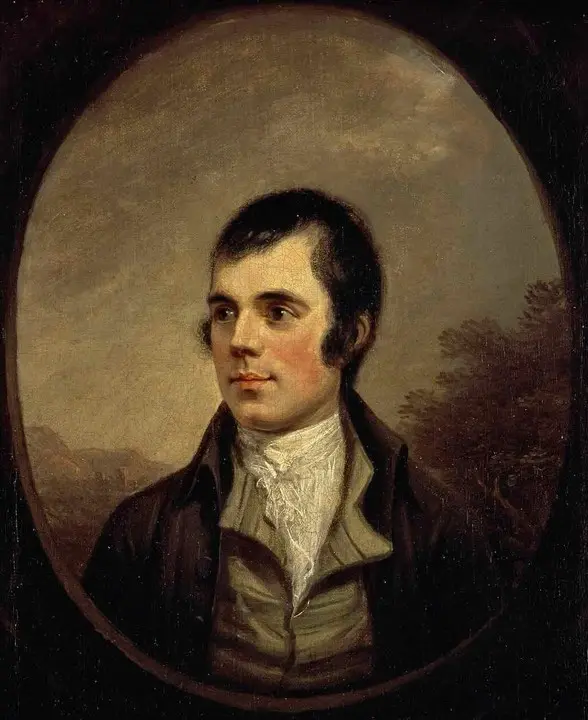

Robert Burns wrote in Scots and English, moving easily between satire, love poetry, political observation, storytelling, and song. His work survives both on the printed page and through communal performance.
A practical reading list
- To a Mouse — compassion, disrupted plans, and the uncertainty shared by people and nature.
- To a Louse — comic social observation and a warning about seeing ourselves as others see us.
- Tam o’ Shanter — a narrative poem filled with drink, supernatural danger, pursuit, and unforgettable Scots imagery.
- A Man’s a Man for A’ That — an enduring statement about dignity and equality.
- Address to a Haggis — the ceremonial centerpiece of a traditional Burns supper.
- A Red, Red Rose — one of Burns’s best-known expressions of love.
- Scots Wha Hae — a patriotic song framed as an address by Robert the Bruce.
- Auld Lang Syne — Burns’s adaptation of an older song tradition, now sung internationally at moments of farewell and renewal.
- Holy Willie’s Prayer — sharp satire directed at hypocrisy and self-righteousness.
- The Cotter’s Saturday Night — a portrait of family, work, worship, and rural Scottish life.
Read the works alongside reliable editions and museum collections when comparing Scots-language wording, musical settings, manuscripts, and later adaptations.